17 May 2026 · Maison Zola
Pet memorial portraits: how families honor a beloved companion
A painted portrait has long served as a form of remembrance. How families across eras have honored beloved pets, and why the tradition endures.
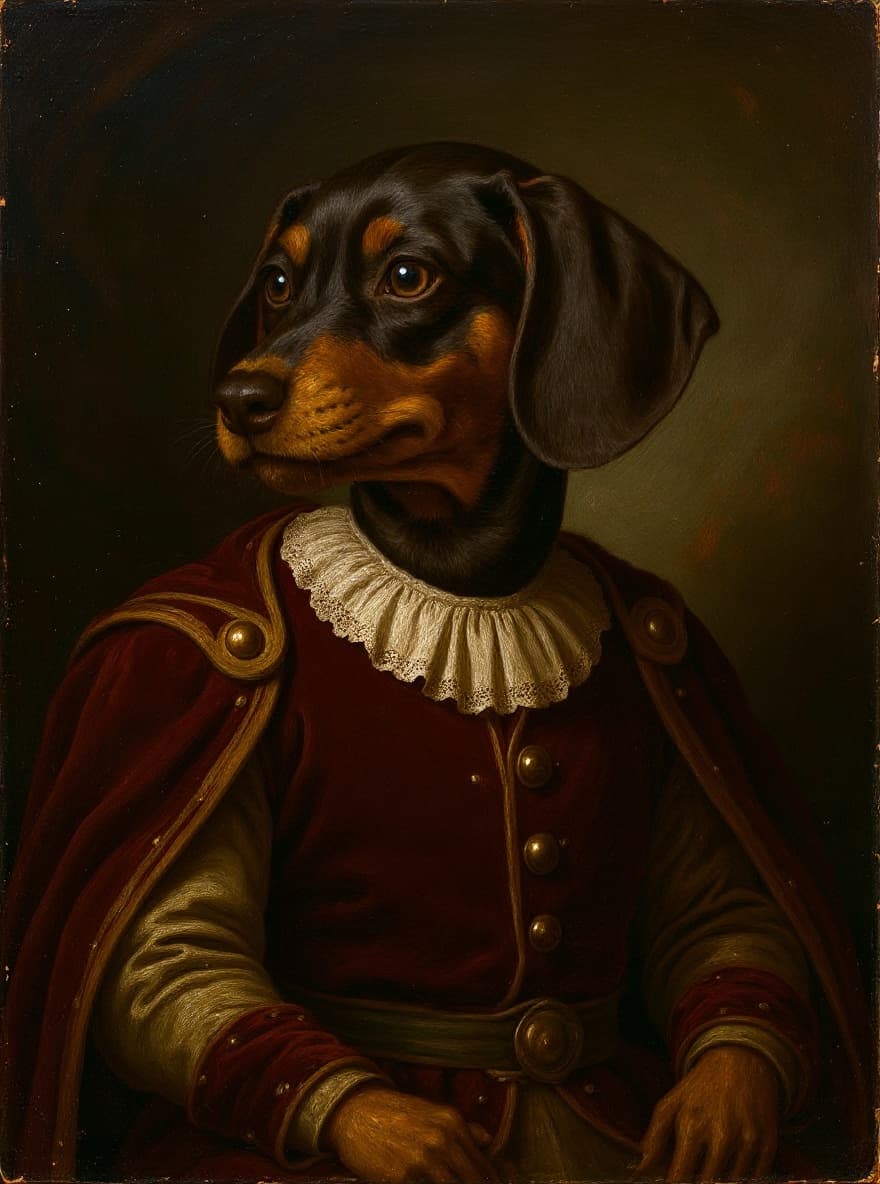
The object that remains
Grief has always looked for something to hold. After the death of a dog or a cat who has shared a household for a decade or more, the photographs feel insufficient. They are flat, contingent, taken on an ordinary afternoon. A painted portrait is a different kind of object. It is made with intention, in the full knowledge of what has been lost.
This is not a modern instinct. The impulse to commission a likeness after death runs through European domestic life for centuries, and the animal companion was never far from the center of it.
A brief history of animal mourning
The seventeenth century Flemish masters painted dogs as presences, not props. In the great dynastic portraits of Van Dyck and his circle, the family dog sits at the edge of the composition with the same gravity as the children. When those dogs died, their likenesses remained on the wall. The portrait was already there; it became, over time, a memorial.
By the eighteenth century, the posthumous animal portrait had become a recognized form. George Stubbs painted horses and dogs in the English country house tradition with a precision that bordered on scientific, and his patrons understood that the painting would outlast the animal. The commission was partly anticipatory mourning: to have the likeness made while it could still be observed, so that it might serve later as a record of presence.
The Victorian period formalized grief into a material culture. Mourning lockets, hair work, jet jewelry: all of it was organized around the idea that loss required a physical object. Animals were included. Queen Victoria's grief at the death of her collie Sharp, her dachshund Dacko, and above all her beloved Skye terrier Islay was documented and public. She commissioned portraits and kept them. The painted image was not sentiment; it was evidence that the animal had existed, had mattered, had been known.
What a portrait does that a photograph cannot
A photograph is a record of a moment. A portrait is a record of a character. The painter works from photographs, yes, but the act of painting requires sustained attention to the particular: the way a dog's brow carries its habitual expression, the specific quality of a cat's gaze, the posture that was unmistakably theirs and no one else's.
This distinction matters most in grief. The photographs of a lost companion tend to accumulate a kind of unbearable specificity. The last photograph, the last good day, the last ordinary afternoon. A painted portrait steps back from that chronology. It presents the animal as they were across time, not at a single moment. The expression the painter renders is the expression the family recognized over years.
There is also the question of scale and material. A painted portrait on archival board or canvas is an object with weight and permanence. It can be framed and hung. It occupies a room the way the animal once did. It is, in the most literal sense, a presence.
The memorial commission
Families who come to the atelier after a loss often describe the same experience. They have been living with photographs on a phone screen, unable to print them, unable to decide which one is right. The act of choosing a reference photograph for a portrait is, for many, the first step toward a different relationship with grief. It requires a decision about how they want to remember: which expression, which angle, which quality of light.
Our memorial pet portraits are painted from the photographs you provide. We work with what you have, and we understand that the photographs taken in the last months of an animal's life are often the most tender and the most difficult to look at. The painter's task is to take those images and render from them not the illness or the age but the character that persisted through it.
Some families commission a portrait in the weeks after a loss. Others wait a year or more. There is no correct interval. The portrait will be the same whenever it is made. What changes is the family's readiness to look.
How the tradition has been carried forward
The lineage of the painted animal portrait runs from the Flemish still-life tradition through Stubbs and Landseer, through the Victorian parlor and into the twentieth century. Sir Edwin Landseer, whose work hung in every serious English household of the mid-nineteenth century, understood that the dog in a painting was never merely a dog. It was a relationship, a household, a set of daily rituals made permanent.
Our atelier sits in Mont de l'Enclus, in the Belgian countryside, and we paint into the tradition that runs from Rubens and Van Dyck through the great Flemish portrait painters. The custom pet portrait we make for a family today is continuous with that tradition, not in imitation of it but in the same spirit: a serious rendering of a subject that deserves serious attention.
The animal companion has always occupied an ambiguous place in the human household. Not a person, and yet not merely an animal either. The portrait acknowledges that ambiguity without resolving it. It simply says: this creature was here, was known, was worthy of a painter's sustained attention.
On grief and the painted image
There is a passage in the letters of the sixteenth century humanist Erasmus in which he describes a friend's attachment to a small dog with the same vocabulary he would use for a human friendship. The dog was a companion in the full sense. Its death was a loss in the full sense. The language of mourning was available to both.
This has always been true, even when it was not officially sanctioned. Families have always grieved their animals. What has changed, across the centuries, is the degree to which that grief is acknowledged in the objects a household keeps.
A painted portrait is one of the oldest forms of that acknowledgment. It predates the photograph by several centuries. It will outlast the digital image by several more. The pigment and the ground, properly prepared and properly stored, will hold the likeness for generations. The animal who was known only to one household becomes, in the portrait, knowable to anyone who stands before it.
That is what the memorial portrait does, finally. It takes the private fact of love and loss and gives it the permanence of paint.