30 May 2026 · Maison Zola
Painting the Rottweiler: notes from the atelier
How the Rottweiler's black-and-tan coat, broad skull, and watchful gaze shape every decision in the studio, from light source to chosen style.
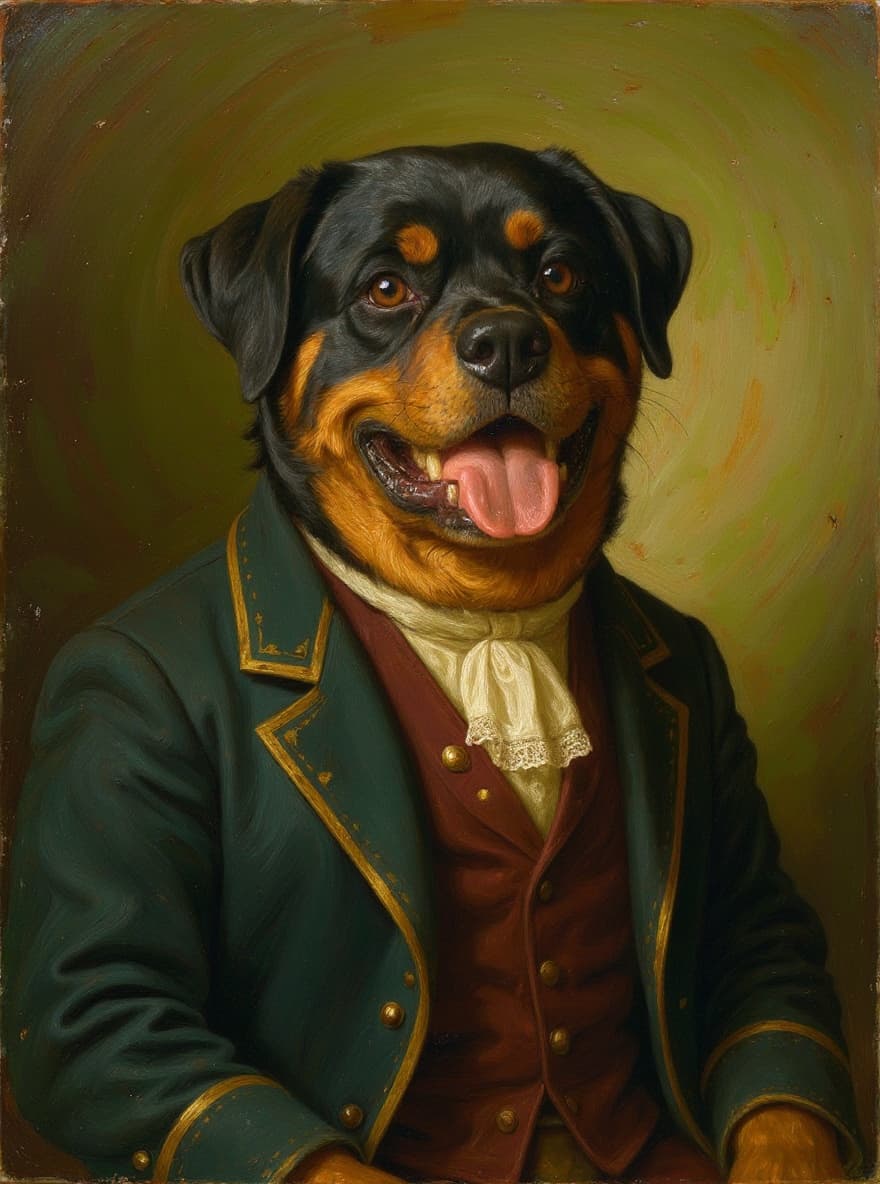
The dog that has been doing this for two thousand years
The Rottweiler walks into the studio and the painter, almost involuntarily, takes a half-step back. Not out of caution. Out of respect.
The breed has a presence the rest of the catalogue can only approximate. Some of it is structural: the broad skull, the deep chest, the muscle that sits clearly under the smooth coat. Some of it is older than structure. The Rottweiler is, in the most literal genealogical sense, descended from the drover dogs the Roman legions used to herd cattle across the Alps. The breed has been doing serious work, in serious company, for roughly two thousand years. You feel that when one is in the room with you.
When a Rottweiler portrait arrives at the atelier, the first decision is to honour that history. The painter is not adding gravity to the breed. The breed already has more gravity than most of what we paint, and the painter's job is to not get in the way of it.
A brief and partial history
The Rottweiler does not have a Landseer.
That is, when you list the major nineteenth-century painters who took particular breeds seriously, the Rottweiler is not on the list. There are reasons for this. The breed spent most of its modern history not in English drawing rooms but in German market towns, doing the work it was bred to do: herding cattle and guarding the proceeds. Sir Edwin Landseer painted Newfoundlands, deerhounds, and pointers because those breeds shared the country house with him. The Rottweiler shared the cattle market with a butcher in Stuttgart.
The breed surfaces in painting somewhat late, then. Mid-to-late nineteenth century German bourgeois portraiture occasionally includes a Rottweiler at the feet of a master butcher or a city official. The art-historical record is thinner than for the spaniels and the retrievers; you have to look in different rooms.
What the older German painters got right, and what the atelier is trying to recover, is the breed's combination of stillness and weight. A Rottweiler at rest is not relaxed. It is on watch. The face is calm, the body is loose, but the dog is paying attention, and the painter has to find a way to show that without tipping into either menace or sentimentality.
The coat, which is a particular problem in oil
The Rottweiler's coat is short and dense, and it presents the painter with one of the harder colour problems in the breed catalogue.
The base of the coat is black. Not a stylised black, not "black with shadow." Genuinely black, with the kind of saturation that absorbs studio light rather than reflecting it. The tan markings, set above the eyes, on the cheeks, on the chest, and along the legs, are warm and bright by comparison. The transition between the two has to be resolved in every Rottweiler painting.
A flat black coat in oil is a trap. Painted as a single tone, the dog reads as a silhouette rather than a body. We work the black up from a warm umber underpaint, letting flecks of brown and burnt sienna show through in the planes that face the light. The black on the shadow side of the dog can stay close to true black; the black on the lit side has to be modulated, sometimes more than the painter's instinct suggests. The dog should read as a solid form with light playing across it, not as a piece of black paper cut into a dog shape.
The tan markings are warmer than they tend to look in a photograph. We paint them slightly more saturated than the source image suggests, partly because oil dulls warm tones as it dries and partly because the tan needs to hold its own against the black or it disappears into a kind of overall middle value. The eyebrow markings in particular are critical to the face reading correctly. Without them the brow flattens.
The smooth coat shows muscle. We let it. The line of the shoulder, the curve of the haunch, the chest tapering to the front legs, these are the structural facts the breed presents to the painter, and the painting works best when they are visible.
The face
The Rottweiler's face is built around the eyes.
The skull is broad and the muzzle is medium-length and slightly tapered. The lips are loose enough to show a hint of tongue at rest but not so loose that they hang. The cheeks are well-muscled. The eyes are almond-shaped, dark, and set slightly forward in the skull. The expression is what the breed standard calls "noble, alert, and self-assured." That is accurate.
What the painter needs to capture, more than the structural correctness of any individual feature, is the quality of attention in the eyes. A Rottweiler is almost always paying attention. The eye is dark, but it is not flat. The white of the eye, when it shows at all, shows at the inner corner; the rest of the eye is dark on dark, and the painter has to find the curve of the eyeball inside that darkness with very small value differences.
The highlight, as always, sits at about ten o'clock on the iris, modest in size and warm in tone. A Rottweiler painting with a too-bright highlight reads as alarmed. The breed is not alarmed; the breed is paying attention. The highlight has to suggest the moisture of the eye, not the reflection of a stage light.
The mouth should be closed in the photograph, or very slightly open. The Rottweiler's resting expression is composed. Photographs that show the dog mid-bark or mid-pant carry that energy into the painting, and the painting then reads as aggressive, which is almost always a misrepresentation of the actual dog.
Choosing a style for the Rottweiler
The breed sits well in The Oil, and that is the style we recommend for most Rottweiler commissions. The Oil treatment is the most direct of the three studio styles, the most formally serious, and the most likely to produce a painting that reads as a real portrait rather than a costume drama. For a breed with two thousand years of working history, the costume drama is the wrong register.
The Atelier (the seventeenth-century Flemish vocabulary) can also work, particularly with the black ground supporting the dark coat. The risk with The Atelier is that a black coat against a dark ground produces a painting that reads as too uniformly dark; we sometimes lighten the background ground slightly when painting a Rottweiler in this style to give the coat room to register.
The Sovereign treatment, the coronation regalia, we use sparingly with this breed. The Rottweiler is not, by character, a court dog. The combination of the breed's working gravity and the theatrical period costume produces a painting that often looks like the dog is being asked to do something it would prefer not to do, which is exactly the wrong tone for the breed. There are individual Rottweilers (often slightly older dogs with softer faces) where The Sovereign can succeed, but it is not the default.
What the photograph needs to give us
Every custom dog portrait starts with a photograph, and the Rottweiler is moderately demanding about the photograph's qualities.
Light. Directional, but soft. A north-facing window or a softbox at about forty-five degrees to the dog. Hard sunlight will deepen the brow shadow and lose the eyes; flat overcast light will remove the structural information we need from the coat and the underlying musculature.
Angle. Near-frontal, ten to twenty degrees off centre. The breed has a strong silhouette from the side, but a side angle loses one of the eyes, and the eyes are where the painting lives.
Posture. Settled, alert, neither tense nor sleepy. A Rottweiler photographed in a "guard" stance reads as menacing in oil. A Rottweiler photographed mid-yawn reads as exhausted. We want the dog at rest, paying attention to whoever is holding the camera.
Mouth. Closed, or with the lower lip just slightly relaxed. Not panting. Not barking. The Rottweiler's lips at rest are heavy enough that any open-mouth photograph will read as aggressive in the finished painting.
One specific note. Photograph the dog from approximately its own chest height, not from human eye level. A Rottweiler photographed from above looks smaller than the breed actually is, and the broad chest and shoulders that give the breed its presence get foreshortened away.
The breed in the long tradition
The Rottweiler arrives in our atelier with two thousand years of working seriousness behind it, and the painting we produce is, in the best case, a small contribution to that record. We are not the breed's first painters. We are not its most important. But we paint the breed the way the older German painters tried to paint it, with the respect due to a dog that has been doing real work in serious places for longer than most countries have existed.
A successful Rottweiler portrait does not flatter the breed. The breed does not need flattering. The painting's only job is to show the dog as the dog is, in good light, paying attention, on a wall that is going to be looking back at it for the next forty years.
That is what we are doing this for.