22 May 2026 · Maison Zola
Painting the French Bulldog: notes from the atelier
How the French Bulldog's brindle coat, bat ears, and wide-set eyes shape every decision in the studio, from lighting angle to period style.
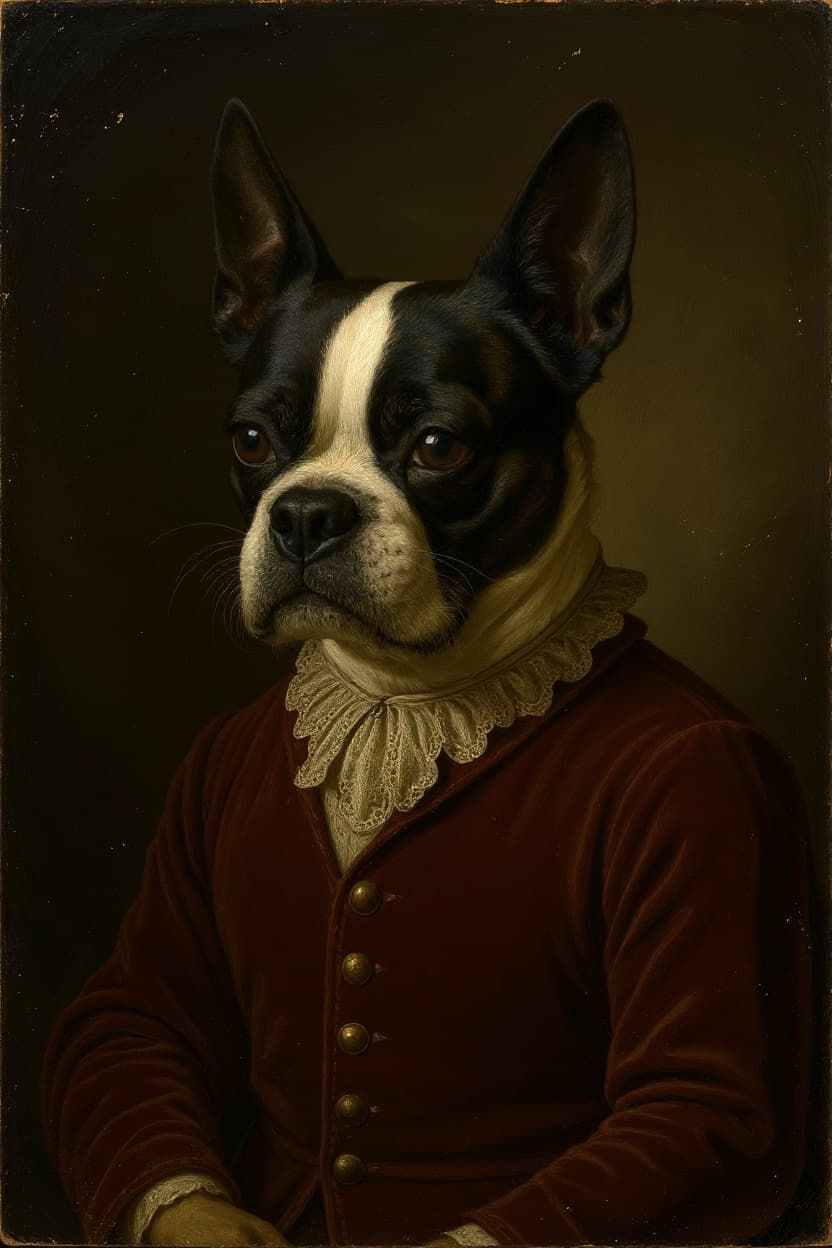
The dog that arrived in the studio already composed
The French Bulldog does not need much help from the painter. The ears are already architectural. The muzzle is already compressed into a near-perfect horizontal plane. The eyes sit wide and forward, catching light in a way that most breeds do not. When a French Bulldog portrait arrives on the easel, the compositional decisions have already been half-made by the breed itself.
This is not to say the subject is easy. The same features that make the French Bulldog so legible as a painted form also make every error legible. A slightly wrong angle and the muzzle reads as flat rather than foreshortened. A light source placed too far to the side and the wide-set eyes lose their symmetry, the face tips into something unbalanced. The breed rewards careful study before the first mark is laid down.
A brief history of the breed as a painted subject
The French Bulldog entered the visual record in earnest during the 1880s and 1890s, when the breed was already a fixture of Parisian café and working-class domestic life. Théophile-Alexandre Steinlen, whose illustrations for the Montmartre press gave the period much of its visual shorthand, returned to the breed repeatedly. His French Bulldogs appear in the margins of street scenes, in the laps of laundresses, at the feet of café habitués. They are never incidental. The compact body and the upright ears made them easy to read at small scale, which suited the illustrated press.
The circle around Henri de Toulouse-Lautrec shared this affection. The dog appeared in the bohemian interiors that Lautrec and his contemporaries painted and lithographed: low light, close rooms, the human subject usually distracted, the dog alert. That alertness is the key. The French Bulldog does not recede into a composition. It watches.
By the early twentieth century the breed had crossed the Channel and the Atlantic, and with it came a new register: the city dog made formal, the companion of the bourgeois apartment rather than the working street. Painters in this period began to treat the French Bulldog with the same seriousness they gave to terriers and spaniels, the breeds that had long occupied the tradition of formal animal portraiture.
The coat: brindle, pied, and the problem of surface
The French Bulldog's short coat is one of the more demanding surfaces in animal painting, for a reason that is not immediately obvious. Short-coated breeds offer no texture to hide behind. The Golden Retriever's long coat can absorb a slightly uncertain passage of brushwork; the Maine Coon's mane creates its own rhythm. The French Bulldog gives the painter nothing of the kind. Every plane of the body is visible, every transition from light to shadow must be resolved.
Brindle is the coat pattern that tests the painter most directly. The interleaving of dark and light hairs produces a surface that is neither solid nor broken, and which shifts in quality depending on the direction of the light. In flat, diffuse light, brindle reads as a uniform dark tone. In directional light, raking across the coat at an angle, the individual hair groups catch and separate, and the pattern becomes visible as a kind of low relief. We paint brindle coats in directional studio light for exactly this reason: the texture needs a single clear source to declare itself.
Pied coats, the white ground broken by patches of brindle or fawn, present a different problem. The white areas are never simply white. They carry the reflected color of the studio, the warm tone of a nearby ground, the cool shadow of the ear above. Painters who treat pied white as a neutral miss the coat entirely. We mix the white passages warm or cool depending on what the light is doing, and we let the transitions between white and colored patches breathe rather than drawing them as hard edges.
Fawn and cream coats are the most forgiving of the three, and also the least interesting to paint. The even tone reads well in most lighting conditions, but it asks little of the painter and gives little back. We tend to reserve the more theatrical period styles for fawn subjects, where the costume can carry some of the visual weight that the coat does not.
The face: muzzle, eyes, and the question of angle
The French Bulldog's face is organized around two competing horizontal forces. The muzzle is compressed, almost vestigial, pulling the lower half of the face inward. The ears rise above, wide and upright, pulling the silhouette outward. The eyes sit between these two forces, large and round and set far enough apart that they register as a pair of separate light sources rather than a single focal point.
This geometry dictates the painting angle more firmly than with almost any other breed. A three-quarter view, which is the default of the portrait tradition from Van Dyck forward, works well for most dogs. With the French Bulldog it must be used carefully. Turned too far from the frontal plane, one eye recedes and the bilateral symmetry that defines the breed's face is lost. The subject begins to look asymmetrical in a way that reads as a fault rather than a perspective.
We paint French Bulldogs at a near-frontal angle, typically ten to fifteen degrees off center. This preserves the symmetry of the eyes and allows the muzzle to read as foreshortened rather than absent. The ears, at this angle, frame the face without competing with it. The composition is slightly more static than a full three-quarter turn, but the breed's own alertness compensates: a French Bulldog looking directly toward the viewer carries its own energy.
The eyes themselves are the expressive center of any French Bulldog portrait. They are prominent enough to catch the light directly, which means the highlight placement is critical. A highlight set too high reads as glassy. A highlight set too low loses the sense of a curved, wet surface. We place the primary highlight at roughly the ten o'clock position on the iris, which is where a single high studio light would naturally fall, and we keep it small enough that the dark iris retains its depth.
Choosing a style for the French Bulldog
The breed sits comfortably across all three of our studio styles, but it does not sit in them equally.
The Renaissance portrait suits the French Bulldog well. The dark ground of the seventeenth century Flemish tradition throws the pale areas of the face forward and absorbs the complexity of a brindle coat without flattening it. The period costume, the ruffled collar and the velvet doublet, plays against the breed's naturally patrician bearing. There is something in the French Bulldog's heavy brow and upright posture that reads as inherently formal, and the Renaissance vocabulary meets it there. We treat the brow with restraint in this style: the goal is gravity, not caricature.
The Royal style is the most theatrical choice, and it works best with fawn or pied coats where the pale ground of the ermine and the cream of the subject create a coherent tonal register. A dark brindle French Bulldog in full coronation regalia can read as too uniformly dark in the lower half of the canvas; we compensate with careful attention to the ermine trim and the gold of the crown, which bring light back into the composition.
The Classic portrait, the most direct rendering of the subject without period costume, allows the coat and the face to carry the full weight of the painting. For brindle subjects in particular, this is often the right choice. The coat is already complex enough to sustain a composition on its own terms.
What the photograph needs to give us
Every custom dog portrait in our atelier begins with a photograph, and for the French Bulldog the requirements of that photograph are specific.
The light in the source photograph should be directional rather than diffuse. Overcast outdoor light, or the flat light of a phone camera's front-facing lens, removes the surface information that makes the coat readable. A single window to one side, or a lamp placed deliberately off-center, will give the coat the relief it needs. The shadow side of the face should be visible but not lost: we need to see the structure of the muzzle and the set of the ears even in the darker passages.
The angle should be near-frontal, for the reasons already given. Both eyes should be fully visible and in focus. The ears should be upright: a relaxed or folded ear in the source photograph will read as an error in the finished painting, because the breed's ears are so much a part of its visual identity that any deviation from the upright position looks like a fault rather than a moment.
Expression matters more with the French Bulldog than with most breeds, because the face is so legible. A slightly open mouth, the lower jaw relaxed, reads as ease. A fully closed mouth with the jaw set reads as attention. Both are valid; they produce different paintings. What does not work well is a mouth open wide enough to show the teeth, which in oil tends to read as aggression regardless of the dog's actual mood.
The breed in the long tradition
The French Bulldog arrived in the portrait tradition late, by the standards of the spaniel or the greyhound. Those breeds have centuries of painted precedent, from the hunt scenes of the medieval manuscript to the grand manner portraits of Gainsborough and Reynolds. The French Bulldog entered the record in the cafés and illustrated papers of the Belle Époque, which is a more democratic origin than most.
What it shares with the older tradition is the quality that made it worth painting in the first place: presence. The breed does not disappear into a room or a composition. It occupies its space with a particular combination of alertness and self-possession that painters have recognized since Steinlen first put it in the margins of a Montmartre broadsheet.
That quality is what we are trying to preserve when we paint a French Bulldog portrait in the atelier. Not a likeness only, but the particular weight of attention that the breed brings to any room it enters.