27 May 2026 · Maison Zola
Painting the Bulldog: notes from the atelier
How the English Bulldog's heavy brow, loose jowls, and short muzzle shape every decision in the studio, from light source to chosen style.
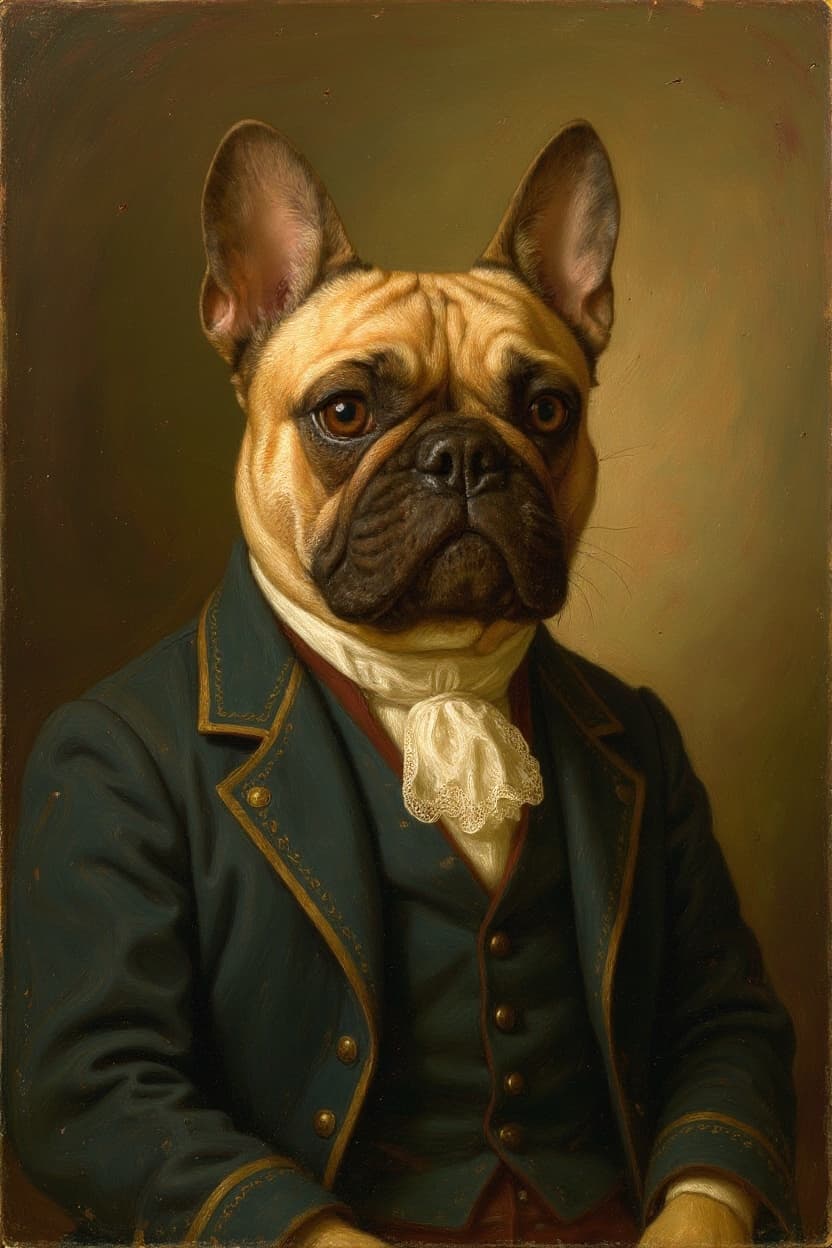
The dog that refuses to be hurried
The English Bulldog enters the studio at its own pace, and once it is settled there is no moving it. This is the first thing a painter learns about the breed, and it is also the most useful. A subject that holds a pose without coaxing is a gift. The Bulldog gives the painter time. It also gives the painter weight: a settled Bulldog occupies its corner of the canvas with the kind of immovable presence that most breeds achieve only in sleep. When a Bulldog portrait arrives on the easel, the first decision is already made for you. The dog is not going to move. The composition has to come to it.
What the breed does not give freely is dignity. The face is loose, the jowls hang, the underbite shows the lower canines. There is a constant risk, when painting an English Bulldog, of producing something that reads as a cartoon: the breed has been so thoroughly absorbed into the iconography of the comic and the picaresque that even a faithful likeness can tip into caricature. The atelier's job is to resist that pull. The Bulldog is a comic figure in a great many contexts, but a painted portrait is not one of them.
A brief history of the breed as a painted subject
The English Bulldog enters the visual record earlier than the French. By the time Edwin Landseer was at the height of his powers in the 1840s and 1850s, the breed was already a fixture of English sporting and domestic painting. Landseer's contemporaries treated the Bulldog with the same level of seriousness they gave to the spaniels and the mastiffs that occupied the grander country-house portraits. The breed appears in the work of the lesser Landseer circle, in the pages of mid-century sporting publications, and in the photographic studios that began to absorb the conventions of the painted portrait toward the end of the century.
What is striking about these earlier images is their restraint. The nineteenth-century painters did not lean into the breed's comic potential. They treated the Bulldog as they treated other working breeds: with attention to bone structure, to the set of the head, to the posture that distinguished an alert dog from a relaxed one. The caricature came later, in the popular press and the political cartoons of the early twentieth century, when the breed was conscripted as a symbol of English stoicism. By that point the painters had largely moved on, leaving the breed to the illustrators.
This is the lineage we are working in. The atelier is trying to recover the older painted tradition, before the cartoon flattened the breed into a mascot. The reference points are Landseer, the sporting illustrators, the formal animal portraitists who painted the breed as they would have painted a horse or a hunting hound. Not the bowler-hatted bulldog of the cigar advertisement.
The coat and the structure beneath
The Bulldog's coat is short, smooth, and unremarkable on its own terms. It is not the coat that makes the breed difficult to paint. It is what the coat sits over: a body that carries a great deal of loose skin, particularly around the neck and the shoulders, and which folds and bunches in ways that no other short-coated breed quite matches.
The painter has to read the skin and the underlying structure as two distinct surfaces. The skin moves. It catches its own shadows, falls into pockets, gathers at the dewlap and the shoulder where the body is broadest. The structure beneath is solid: a deep chest, a short and powerful back, hindquarters that are noticeably smaller than the forequarters. If the skin is painted without the structure, the dog looks soft. If the structure is painted without the skin, the dog looks tense in a way the breed never is. The two have to coexist on the canvas, and the seam between them is where most Bulldog paintings either succeed or fail.
We work the underlying form first, in a flat warm underpaint, and we let the skin and its folds emerge as a second pass over the top. The technique is conventional for any breed with loose skin: the Mastiff, the Saint Bernard, the Neapolitan. But the Bulldog asks for more patience than most. The folds are smaller, more numerous, and more closely packed than on the larger breeds. Each one needs its own value decision.
The face: brow, eyes, jowls
The Bulldog's face is the densest passage in the painting. Everything happens in a small area. The brow is heavy and projects forward over the eyes. The eyes themselves are small, dark, set wide and slightly low in the skull. The muzzle is short, compressed, and pushed in at the bridge. The jowls hang below the lower jaw, framing the underbite and giving the face its characteristic horizontal weight.
The challenge for the painter is to keep all of these elements legible at once without letting any single feature dominate. The heavy brow can easily become the whole painting, particularly under directional light. We use a softer, more diffused light source on the upper face than we would for most breeds, and we save the strongest directional light for the shoulders and the chest where the structure benefits from sharper modeling. The face is meant to gather attention, not to demand it.
The eyes are small, but they are not minor. The Bulldog's eye is set deep beneath the brow, which means it lives in shadow most of the time. The painted eye has to find its way out of that shadow without becoming a bright spot that pulls focus from the rest of the face. We mix the iris warm, almost mahogany rather than black, and we keep the highlight modest. The expression is in the lower lid more than the upper: a slight droop reads as the breed's natural calm; a tighter line reads as alertness.
The jowls and the underbite are where the cartoon risk is greatest. Painted too literally, they read as comic. We treat the jowls as we would treat any large fold of cloth: with attention to the way they cast their own shadows and to the warm reflected light underneath them. The underbite is acknowledged but not emphasized. The lower canines, when visible at all, are softened into the surrounding flesh rather than drawn as separate elements.
Choosing a style for the Bulldog
The breed sits well in The Oil, the most classical of our three studio styles, and it is the style we recommend for most Bulldog commissions. The reasoning is practical. The Oil treatment carries the strongest formal tradition, the most direct line back to the nineteenth-century sporting portraits, and the lowest risk of tipping the breed into the comic register that has shadowed it for a hundred years. A Bulldog in The Oil reads as a serious painted subject, which is the recovery the atelier is trying to achieve.
The Atelier treatment can also work, particularly for white or pied subjects where the pale ground of the coat plays well against the dark gravitas of the seventeenth-century Flemish vocabulary. The brindle Bulldog is more difficult in this register: the coat absorbs the dark ground rather than playing against it, and the resulting painting can read as heavy without the formal compensations that the Atelier style usually provides.
The Sovereign treatment we use sparingly with this breed. The combination of an English Bulldog in coronation regalia carries an inescapable echo of the Churchillian cartoon, and even a serious treatment of the subject struggles to escape that association. There are subjects, particularly fawn or pied dogs with a quieter expression, where the Sovereign style can succeed. For most commissions we steer toward The Oil.
What the photograph needs to give us
Every custom dog portrait we paint begins with a photograph, and the requirements for the Bulldog are specific. The dog should be photographed seated or standing in a relaxed posture, head facing the camera at a slight angle, no more than fifteen degrees off the frontal plane. The face is too dense and too horizontal to read well from a sharp three-quarter view. We need to see both eyes clearly, both ears, and the full breadth of the jowls.
The light should be directional but soft. Hard sunlight will exaggerate the brow shadow and lose the eyes. Flat overcast light will flatten the entire face and remove the structural information we need from the skin folds. The right source is a north-facing window or a softbox at roughly forty-five degrees to the dog, raised slightly above eye level. The shadow side of the face should be visible. The shoulder and chest can take a stronger light, which helps with the modeling of the underlying structure.
Posture matters more than expression with this breed. A relaxed Bulldog reads as itself; a tense or panting Bulldog reads as a different dog. If the source photograph catches the dog mid-yawn or mid-pant, the painted likeness will carry that expression and there is no good way to correct it in oil. We ask for a settled subject, and the breed obliges more readily than most.
The mouth should be closed or just slightly open. An open mouth showing the tongue is a common photographic posture for the breed, but it tends to read as caricature in a finished painting. The closed mouth, or the very slightly parted lower lip that the breed often holds at rest, gives the painter the dignified expression that the atelier is trying to preserve.
The breed in the long tradition
The English Bulldog has occupied an unusual position in the portrait tradition. The breed was painted seriously by serious painters for the first eighty years of its modern existence, and then it was largely abandoned by painting and absorbed by illustration. The recovery, when it comes, has to push against a century of accumulated cartooning.
What the older painters saw, and what the atelier is trying to see again, is the particular quality of presence the breed brings to any room. The Bulldog does not perform. It settles. It watches without urgency. It carries weight in a literal and a figurative sense, and that weight is the painted subject worth pursuing.
A successful Bulldog portrait is one that returns the breed to the company it kept in Landseer's day: the formal animal portrait, the serious painted likeness, the dog as a subject in its own right rather than a symbol of an idea. The atelier paints toward that earlier register, and the breed itself does most of the work, simply by being what it is.